

handcast, recast: aluminum, 2025
resulted in the collection “sonra”

Sonra, meaning “later” or “after” in Turkish, is a meditation on transformation, both material and cultural. This collection reimagines aluminum, once the backbone of modern industry, as a sculptural medium for the table and home. Handcast in recycled metal, each piece is shaped through a process that honors slowness, memory, and precision.
The forms draw inspiration from the mid-60s works of American artist Paul Feeley, whose curving, symmetrical compositions hovered between object and ornament. His language of shape is reinterpreted here in cast aluminum, stripped of color and redefined through texture and mass.
At the heart of Sonra is a collaboration with Ustas, master artisans whose work carries generations of knowledge. In our tradition, an usta is more than a skilled hand. They are custodians of methods, gestures, and stories that shape both material and meaning. Each object in the collection was handcast in a traditional foundry in the heart of Karaköy, Istanbul’s historic trade district. Among the narrow alleys and aging hans -workshop courtyards-, these workshops still echo with the sound of fire and metal.
Aluminum casting by hand is a disappearing practice in Istanbul. This project became an act of revival. Together with the ustas, we reawakened forgotten rhythms. What emerged was not just form, but a renewed bond between design and making. The artisans brought laughter, care, and deep intuition to every cast. Their presence is felt in every curve.
Each piece is made from reclaimed aluminum. The casting takes place in Istanbul. Finishing, refinement, and final touches happen in our Amsterdam atelier. From one city to another, the material travels, changes, and settles into its new form.
Sonra is a tribute. To the ustas. To the tradition. To the persistence of handcraft in an age of speed. And to the idea that the future can be shaped from what we already hold.
Objects in the Collection:
Petal Egg Holder
Orb Egg Holder
Loop
Bask Vase
Kare Serving Coupe
Disciplines
Concept and collection development
Form and object design
Mold design and production
Material sourcing
Artisan collaboration
Finishing and detailing
Art direction
Photography styling


bioceramic: food waste, 2021

This material was not found. It was built, slowly and deliberately, by hand.
What began in 2021 as an experiment with discarded food became the foundation of Atelier Barb. It was our beginning. A material search that taught us how to listen, how to shape, and how to stay with something until it reveals its form.
We weren’t trying to make ceramic. In fact, what we made has nothing to do with ceramic. But we needed a name, and bioceramic was the closest to describe what we were forming: a new material between stone, shell, and pressed pulp.
The intention was simple but ambitious: to find the material of the future. And we did. Every part of this process was developed at Atelier Barb. The material is made entirely from food waste and a plant-based binder we invented through two years of in-house research. It is biodegradable, heat-safe, water-resistant, and durable — a composite that can be pressed, shaped, and finished without industrial tooling. There are no petrochemicals, no filler, no coating. Just waste, time, and formulation.
The forms are molded and cast one by one in our atelier. Each piece carries the memory of its origin — eggshell, artichoke bracts, coffee grounds. It does not pretend to be eternal. It was designed to return. And yet, with care, these objects are remarkably strong. They have lived in homes, restaurants, and studios around the world. They have been used, washed, and loved. Many will last for generations.
To date, this material has given new form to nearly 10,000 eggshells and kilos of food scraps. This is what success looks like to us: beauty grounded in responsibility, and design built from what would have been thrown away.
This project shaped us as much as we shaped it. It deepened our relationship to food, time, and process. It asked us to listen, not to the language of design, but to the voice of material.
Composed to Decompose is not a product line. It is an ongoing search. A refusal to separate aesthetics from responsibility. And a quiet reminder that the future may be built from the scraps of our present, if we learn to pay attention
Objects in the Collection:
Eggshell Egg Cup
Artichoke Candle Holder
Wall Tile Series
Disciplines
Material invention and binder formulation
Object and form design
Mold development and testing
Hand-casting and production
Functional testing
Photography and styling


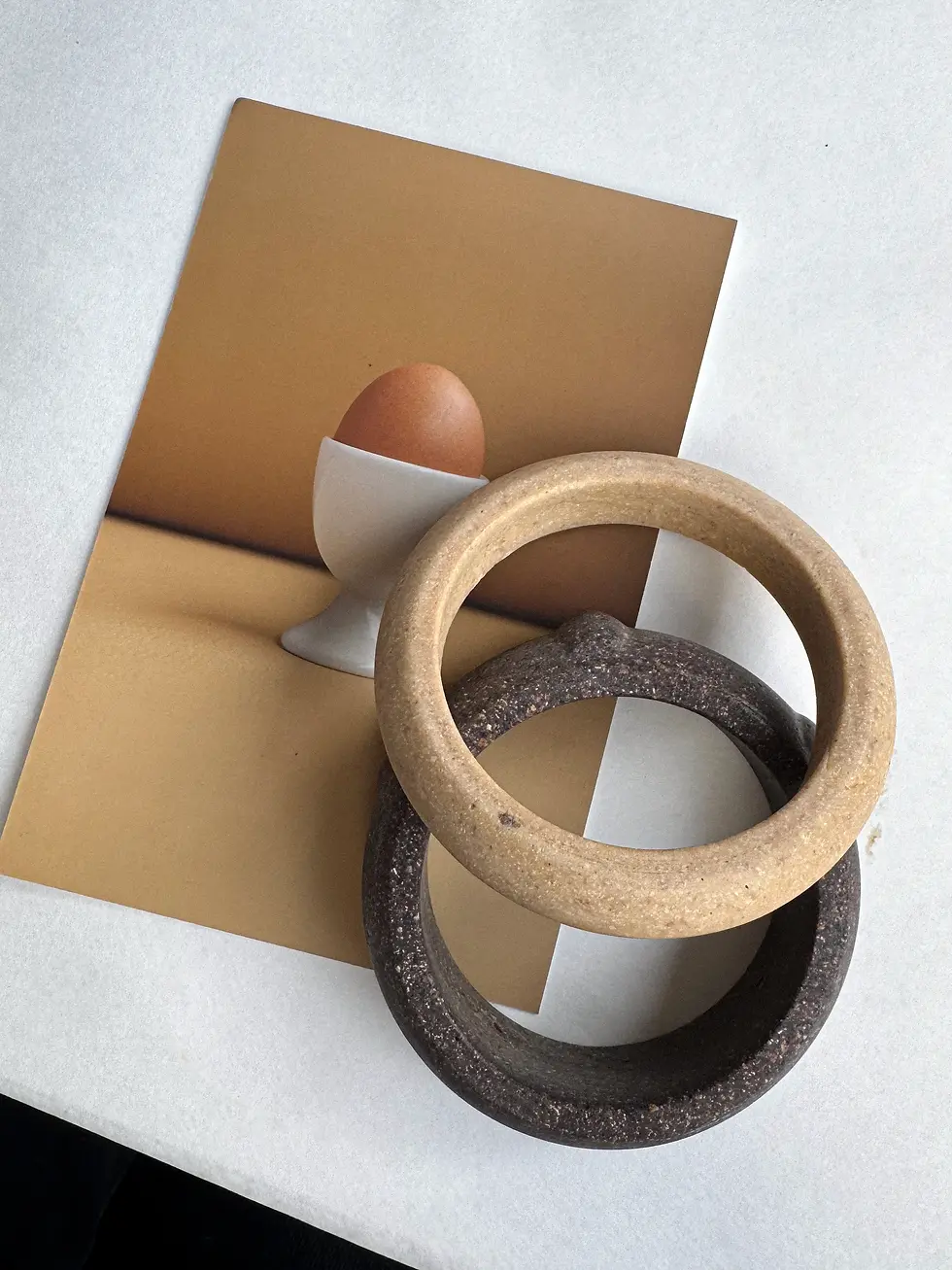


Our Bask Vase from the Sonra Collection was featured at Feisty Feast No.21, a dinner gathering hosted at the Institute of Contemporary Arts (ICA) in London. The event was powered by ASICS SportStyle and curated by Feisty Feast, bringing together artists, athletes, and creatives around a shared table.
The vase was used as part of the tablescape design, reflecting both function and form in a space shaped by ritual, movement, and community.


120 of our Petal Egg Holders were used in a large-scale table installation for Wandler during Amsterdam Art Week 2025. The holders served as sculptural platforms for food designed and prepared by Sabato, forming a rhythmic, reflective composition across the table.
Originally created as functional objects, the egg holders revealed their versatility as modular art forms, bridging the space between serving ware and installation. The experience was set in harmony with paintings by Philippa Atkinson, creating a dialogue between material, food, and visual art.
paris fashion week, 2024
Lafayette Anticipations


Artist Alina Prokopenko (Apris) presented her Edible Lipsticks on Atelier Barb silver plates during the launch of Joshua Woods’ book Fashion Week Diaries. The event took place at Lafayette Anticipations during Paris Fashion Week 2024.
A dinner held during Paris Fashion Week featured Atelier Barb silver plates, continuing from the event Silver 47 Ag, curated by Pirrie Wright and Maria de Sousa.
Inspired by the 1879 book Silver, Its History and Romance, the dinner merged contemporary and antique silver references into a collective dining experience.
Our Bask Vase and Kare Serving Cups were featured in a table installation created by Tabili for a Polestar event, highlighting tactile form and sustainable design in a shared setting.
Silver 47 Ag
Le Pain de la Semaine, 2024, Poilâne, paris

Drawing inspiration from the legacy of Poilâne, the world-renowned French bakery that has elevated bread-making to an art form since 1932, this irreverent exhibition meets holiday shop will cast a spotlight on bread as more than just a staple food—it’s a symbol of creativity, culture, and connection.


digital installation ‘do not sit here’, 2025
Disciplines
Concept development
3D modeling and digital composition
Motion design and rendering
Visual storytelling
Disciplines
Material development
Sheet production
CMF
Tablecloth for King's Day, 2025
Orange peel waste
Amsterdam



Digital Installation by Haydar Bayındır, 2025
A throne built for the fragile.
Do Not Sit Here is a digital sculpture composed of stacked egg holders from the Sonra Collection. The form suggests power but resists function, topped with delicate eggs to make sitting impossible.
The work plays with architectural confidence and material impossibility, reflecting on design as both invitation and resistance. Rendered digitally and exhibited as a still image, it exists in tension between authority and collapse.
This piece marks the beginning of an installation series exploring the concept of the prop — objects made only to perform, then discarded. Here, we reuse what is already in our hands. Repetition becomes form. Waste becomes structure.
biotextile with algae, 2024-2025
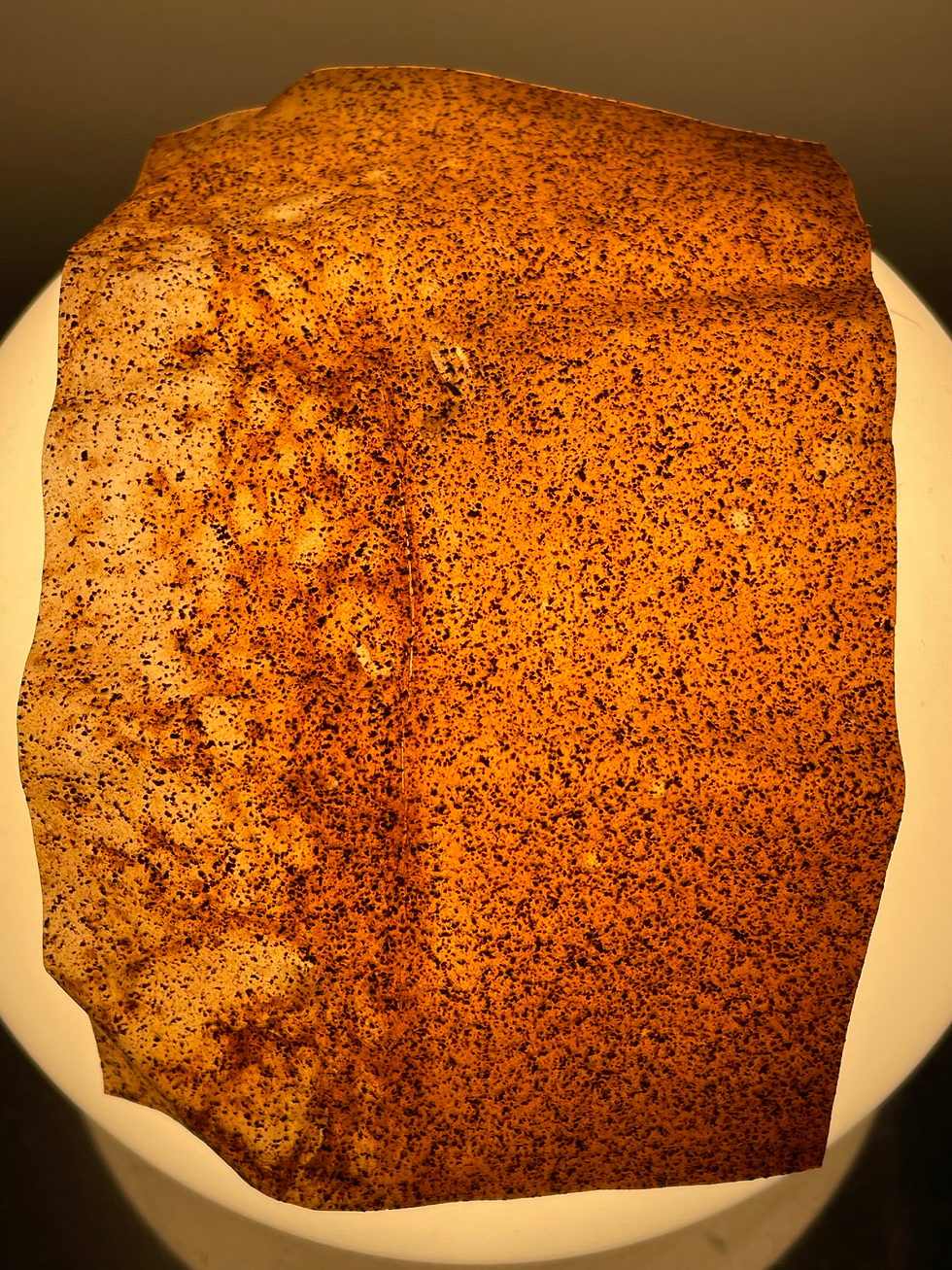
This material is made from algae and plant matter. It is soft, durable, and completely biodegradable.
Developed entirely in-house, our biotextile was created as a long-term alternative to leather and synthetic fabrics. It can be folded, sewn, shaped, and handled like a structured textile. When used with care, it lasts. When composted, it returns to the earth.
We produce it in sheets in our Amsterdam atelier using local waste matter. Each batch carries its own tone and texture, depending on the pigments and organics used. It is water-sensitive, naturally pigmented, and free from plastics, glues, or coatings.
The first editions were created for food events and temporary installations. This material will become part of everyday use. It is a living archive of what is possible when we treat waste as a beginning, not an end.
domino tiles for magalie mobeite
in collaboration with jan van eyck academie, 2024


In June 2024, Atelier Barb collaborated with artist Magalie Mobetie to create a series of biodegradable domino tiles for Jan van Eyck Academie Open Studios. The tiles were made from eggshell-based bioceramic and engraved according to Mobetie’s intentionally designed domino tile patterns.
The work forms part of MANIFEST, a wider research project led by Mobetie that reimagines the collective memory of the transatlantic slave trade through healing, resistance, and ancestral knowledge. Domino tiles — once used to encode medicinal herbal remedies — were long banned in Guadeloupe and other colonies, feared by colonizers as tools for subversion. Mobetie’s designs draw from those histories and from personal memory, passed down from her grandmother.
The final tile series serves as both artwork and archive — a tactile record of resistance, remembrance, and the quiet transmission of care across generations.

Disciplines
Biomaterial development
Mold design and production
Hand-casting
Laser engraving
kafeterya barb, 2024 - present

Food has always been at the center of our work — as material, as memory, and as medium.
One of Atelier Barb’s co-founders, Safiye, is also a food artist. Through her hands, our approach to objects and material experimentation extends naturally into flavor, ritual, and experience. Together, we’ve been developing Kafeterya Barb, a long-form pop-up concept that merges our visual language with her culinary imagination.
Kafeterya Barb is not fixed to one location or format. It moves between tables, markets, events, and installations. It brings together food, form, and function in unexpected ways — often served on objects we design, in settings we compose.
This project is ongoing and always shifting. It is our most sensory space. One that will eventually settle into a permanent home.
Disciplines
Concept development
Food design and menu creation
Object and tableware integration
Spatial storytelling
Scenography
Production and hosting
Bar'b'ites at Tavern, October 2024,
Istanbul


Edible rings for bywayof, July 2024,
Istanbul


Recipe development and
experiments
digital artworks
Disciplines
Creative direction
3D modeling / sculpting
Motion design
Animation and rendering
Conceptual storytelling
Post production
Color grading
Sound design and composing
Original score by Haydar Bayindir


We maintain a growing archive of digital artworks and visual studies that explore the sculptural language of Atelier Barb in motion.
Created by Haydar Bayındır, co-founder of Atelier Barb and a 3D artist, these animations reflect each object’s rhythm, weight, and formal logic in a space unconstrained by material limits. Every piece we design and produce is reinterpreted through digital tools as an artwork in its own right.
This ongoing body of work includes motion studies of our aluminum, bioceramic, and biotextile pieces, expanding the life of each form beyond its physical state.
3d prints: re-pla, 2023


String is a series of digitally composed forms inspired by Czech Cubism and the spirit of the 1920s Jazz Age — reinterpreted through contemporary 3D printing technologies.
Each piece is printed using recycled PLA filament, produced entirely without support material. This approach reduces excess waste and allows the geometry of the object to define its own limits. The result is a series of lightweight yet structured forms with rhythmic, stacked silhouettes.
This project explores how ornament, architecture, and digital fabrication can intersect. The lines echo the past but are shaped by code — looping, extruding, lifting.
String is part of our broader exploration into responsible production through form and restraint. All components are printed in-house using leftover PLA collected from regional sources.
From waste filament to finished form, String is a minimal gesture made through layered repetition.
Disciplines
Concept and form design
Recycled PLA sourcing
No-support print strategy
In-house 3D printing

Commissioned by a private client for use in their restaurant service, this series of sculptural vessels was designed to serve ice cream and other soft, creamy foods.
Each piece is handcarved from solid blocks of edible rock salt sourced from the Anatolian region of Türkiye, shaped in collaboration with artisans who specialize in working with salt as a sculptural material. The vessels gradually shrink and soften with time, subtly seasoning the food they hold as they dissolve.
The object is not permanent. It is designed to disappear — leaving behind no trace but taste.
This project explores salt as both container and ingredient. A functional form that carries, flavors, and eventually vanishes. The possibilities remain open.
Disciplines
Creative direction
Material storytelling
Functional form design
Material sourcing (Anatolian rock salt)
Artisan collaboration
Salt carving
Concept to execution

